
Deciding between Replit vs Lovable, and every comparison seems to test a version that already changed?
The short answer is that Replit is the code-first environment for developers who want control, while Lovable is the design-first builder for non-technical founders who want a polished app from a prompt.
I built the same SaaS dashboard in both, with user auth, metrics, and a Stripe checkout, and ran each through real iteration. Here's how Replit and Lovable compare in ease of use, code quality, backend, debugging, and pricing, plus who each one is best for.
Replit vs Lovable: what's the difference?
Replit is a browser-based AI IDE where you see the code, terminal, and database, built for developers who want hands-on control and flexibility.
Lovable is a conversational app builder where you describe features in chat, built for non-technical founders who want a beautiful, working app fast.
Choose Replit if: you want to code, debug, and deploy in one environment with maximum stack flexibility.
Choose Lovable if: you want the fastest path from prompt to a polished, production-looking UI, no code required.
Meet Replit: features and highlights
Replit is an AI-first cloud IDE that runs in the browser. Its Agent can generate a full-stack app, install dependencies, connect APIs, and deploy, while you keep full access to the code, terminal, and file tree.
Its strength is control and recovery. The Agent reads its own error logs and fixes bugs in a loop, which is why developers rate it well for debugging.
It supports almost any stack, includes a built-in database and hosting, and offers real-time multiplayer editing. For a deeper look, see our Replit review.
Meet Lovable: features and highlights
Lovable is a conversational, design-first builder. You describe an app in plain English, and it scaffolds a React, TypeScript, and Tailwind front end with a Supabase backend for auth and data, producing polished UIs with little effort.
Its strength is speed to a good-looking result. Reviewers consistently note it generates investor-ready interfaces on the first try, and you can export the code to GitHub to keep building. Its limits show on complex logic, where it can get stuck in bug loops.
Replit vs Lovable: at a glance
Pricing correct as of July 2026. Verify with vendor.
Replit vs Lovable: feature-by-feature comparison
Ease of use for beginners
Lovable wins for absolute beginners.
Lovable's whole interface lets you describe what you want in plain English, and the AI generates a complete app with a professional UI that you refine by chatting. There's no code editor to navigate unless you want one.
Replit's Agent builds from prompts too, then hands you a code editor, terminal, and file tree. That environment assumes some familiarity with development concepts, which can overwhelm a true beginner.
Winner: Lovable.
Code quality and UI output
Lovable leads on design, and it's not close.
Lovable defaults to shadcn/ui with Tailwind, producing clean, modern interfaces that look like real products. For anything you'll show users or investors, it looks better with less effort, and its React output is readable for handoff.
Replit's Agent optimizes for working over beautiful. You often get something functional but rough that needs CSS work. It's capable, and UI polish is more variable.
Winner: Lovable.
Backend and stack flexibility
Replit wins on flexibility by a wide margin.
Replit lets you build on almost any stack, with a built-in database, hosting, and support for external APIs and custom infrastructure. You're not locked into one backend model.
Lovable locks you into React plus Supabase. That covers many SaaS needs cleanly, and if you need custom server-side endpoints or anything outside Supabase's model, you write that logic elsewhere.
Winner: Replit.
Debugging and handling complexity
Replit wins clearly once apps get complex.
Replit's Agent executes code, observes what breaks, and fixes it in a loop. In my build, when the Stripe integration broke, it read the error and fixed it in one pass. Adding role-based permissions also went through cleanly.
Lovable required copy-pasting errors into chat, and the same permissions feature triggered a bug loop that took three attempts, burning three credits. Complexity is where its design-first approach strains.
Winner: Replit.
Pricing
Pricing is close at entry, and both models scale unpredictably.
Replit Core starts at $20/month and Lovable Pro at $25/month, both with a free tier. Replit uses a credit system tied to compute and Agent usage, while Lovable meters per prompt, so heavy iteration drives cost on both.
Lovable's per-message model tends to accomplish more per credit for UI work, while Replit's can stretch further for hands-on coding.
For full breakdowns, see our Replit pricing and Lovable pricing guides.
Winner: Tie. Both need real usage modeling before you commit.
What real users are saying
Feedback below comes from verified G2 reviews.
Replit
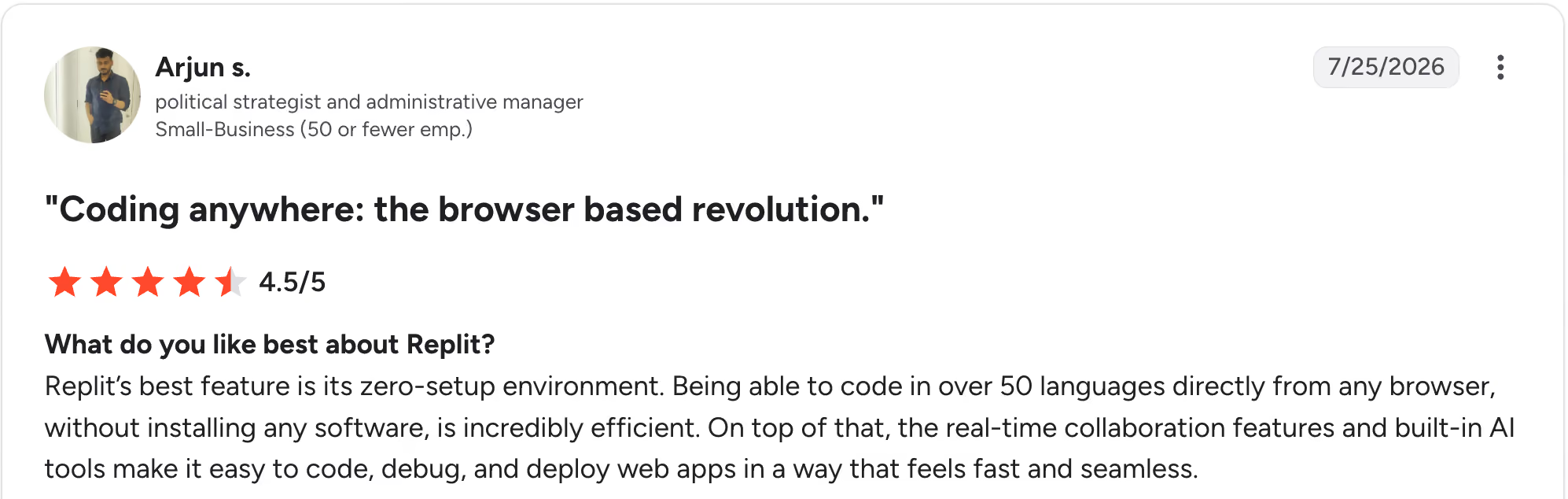
“Being able to code in over 50 languages directly from any browser, without installing any software, is incredibly efficient.” Arjun S, G2
Pros: One G2 reviewer called it "coding anywhere: the browser-based revolution", praising the zero-setup environment, support for 50+ languages from any browser, and the real-time collaboration and built-in AI tools.

“The shift toward a stricter paywall for basic usage, along with performance bottlenecks on lower-tier Replit instances.” Vaibhav T, G2
Cons: The same reviewer flagged a stricter paywall for basic usage and performance bottlenecks on lower-tier instances, where RAM and CPU throttling cause lag or cold-start delays on complex projects.
Lovable
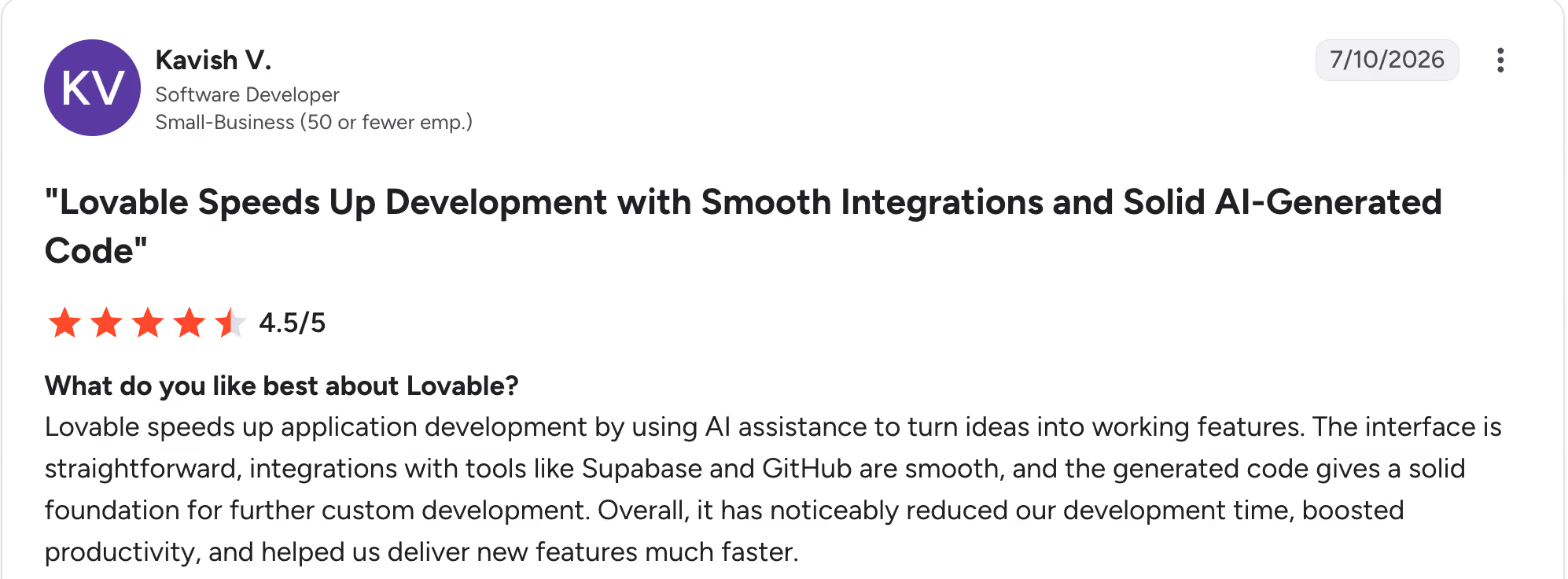
“Lovable speeds up application development by using AI assistance to turn ideas into working features.” Kavish V, G2
Pros: A Software Developer on G2 said Lovable "noticeably reduced our development time", praising the straightforward interface, smooth Supabase and GitHub integrations, and generated code that gives a solid foundation for custom work.

“If they had presented a plan for enthusiasts like myself, that would have been preferable.” Rohit A, G2
Cons: A separate reviewer wanted a plan for hobbyists, found the paid tier hard to justify without large output, and wished it allowed direct repository creation like Cursor.
How to make your choice
Both are strong, and the choice comes down to who's building and what you're building. Lovable is the faster path to a polished, customer-facing MVP, while Replit is the better environment for developers who want control, real debugging, and stack freedom.
Many builders even use both, generating a UI in Lovable and exporting it to a real dev environment to finish.
Replit is better for:
- Developers who want a full cloud IDE with AI
- Apps needing custom backends or specific infrastructure
- Projects where debugging and complexity matter
Lovable is better for:
- Non-technical founders building customer-facing MVPs
- Design-heavy apps you'll show users or investors
- Standard SaaS patterns like auth, dashboards, and payments
My verdict
For non-technical founders who want to ship a good-looking MVP fast, Lovable is the one I'd start with. For developers who want control, debugging, and stack flexibility, Replit is the stronger environment.
If you're weighing either against the broader field, our Replit alternatives and Lovable alternatives guides cover the rest.
Where a prototyping tool stops and governance begins
Replit and Lovable both shine at getting an app built fast. A different question arises when a company wants many teams building internal apps on real business data: who governs what gets built and with what access?
That's a separate layer from either tool. Superblocks is the governed enterprise vibe coding platform, built on a SOC 2- and HIPAA-aligned foundation, where teams build internal apps with AI within IT-set guardrails, with RBAC, audit logs, and code export.
For example, Virgin Voyages had non-technical teams build 15+ production apps across seven departments with governance intact.
If your question is which AI builder ships a prototype faster, the comparison above answers it. If it's how to let a whole company build internal tools safely, that's a different tool.
To try governed app building with a code path back to your IDE, start with the Superblocks Quickstart Guide.
Or book a demo to see Clark AI generating governed apps in your own environment.
Frequently asked questions
Is Replit or Lovable better?
Replit is better for developers who want a code-first environment with debugging and stack flexibility, while Lovable is better for non-technical founders who want a polished app from a prompt. Replit rates higher for coding, Lovable for UI design and beginner ease.
What is the main difference between Replit and Lovable?
The main difference between Replit and Lovable is in their approach: Replit is a code-first AI IDE where you see the code, terminal, and database, while Lovable is a design-first builder where you describe apps in chat and it generates polished UIs on React and Supabase.
Is Lovable or Replit cheaper?
Replit Core starts at $20 per month and Lovable Pro at $25 per month, both with free tiers, so the entry cost is close. Replit uses credits tied to compute, while Lovable meters per prompt. Real cost depends on usage, and both can climb fast during heavy iteration or debugging.
Can you use Replit and Lovable together?
You can use Replit and Lovable together, and it's a common workflow. Many builders generate a polished UI in Lovable, export the code to GitHub, then continue in Replit or another IDE for custom backend work and debugging, combining Lovable's design with Replit's control.
Which is better for non-coders, Replit or Lovable?
Lovable is better for non-coders. Its chat-based interface lets you build a full app by describing it in plain English, with no code editor to learn. Replit's Agent builds from prompts too, then drops you into an IDE that assumes some familiarity with development concepts.
At Virgin Voyages, non-technical teams now build their own AI apps, with IT governance fully intact. The result: 15+ production apps, seven departments onboard, and zero dedicated frontend engineers.
At Matthews, a marketing manager with zero coding background built an app that auto-generates offering memorandums, cutting turnaround from days to hours. See how the brokerage is putting AI builders on every team, with full governance intact.


Stay tuned for updates
Get the latest Superblocks news and internal tooling market insights.
Request early access
Step 1 of 2
Request early access
Step 2 of 2

You’ve been added to the waitlist!
Book a demo to skip the waitlist
Thank you for your interest!
A member of our team will be in touch soon to schedule a demo.
production apps built
days to build them
semi-technical builders
traditional developers
high-impact solutions shipped
training to get builders productive
SQL experience required
See the full Virgin Voyages customer story, including the apps they built and how their teams use them.

"Those tools are great for proof of concept. But they don't connect well to existing enterprise data sources, and they don't have the governance guardrails that IT requires for production use."
Table of Contents
%20(1).png)

Multiple authors
12 AI Agent Deployment Best Practices [2026]
AI agent deployment best practices that move an agent from offline evals to full traffic in stages, with scoped tools and a way to revoke it mid-task.
%20(1).png)
%20(1).png)